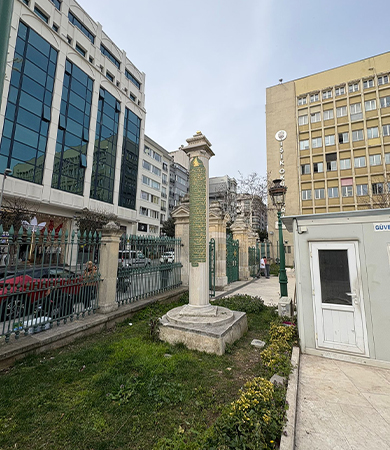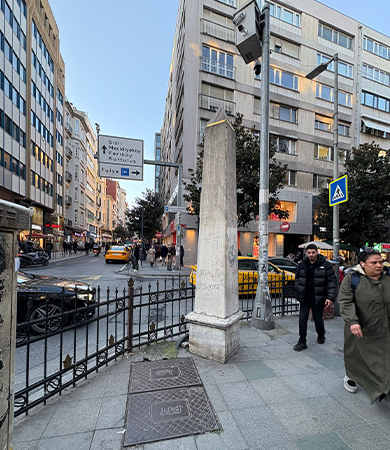





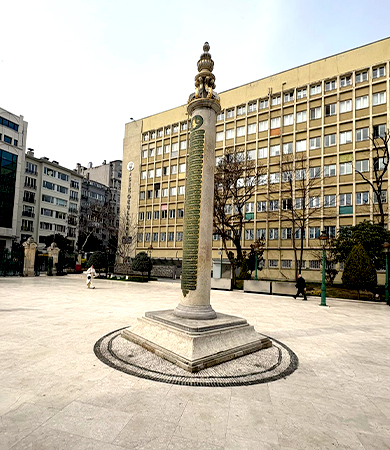
When walking through Nişantaşı, we often focus on shop windows, façades, or the flow of the crowd. Yet what truly defines the character of the district are sometimes the quiet but powerful objects positioned just above eye level. The “nişan stones” are exactly such elements. When you look at them not as entries in a history book but as design objects situated within space, you begin to notice something entirely different: their relationship with voids, their proportions relative to façades, and the way they rise from the ground plane. For an interior designer, these stones are not relics of the past; they are sculptural reference points precisely placed in public space.
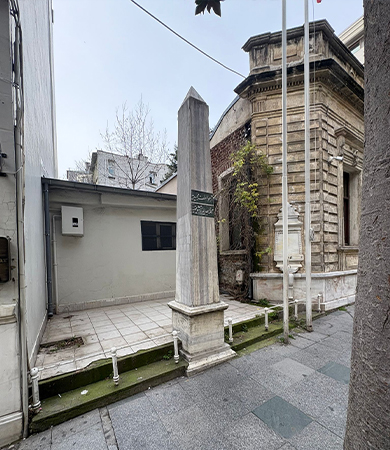
When I look at the stones around Teşvikiye, the first feeling that comes to mind is balance. The calmer and more measured the courtyard or street texture, the more powerfully the stone is perceived. The surrounding apartment façades—the rhythm of windows, horizontal moldings, and natural stone tones—do not suppress this vertical form; on the contrary, they create its background. This effect becomes even more pronounced at intersections. As the flow of people continues, there is a fixed axis at the center, and it feels as though the city moves around it. This is exactly what we call a “focal point” in design.
As you move toward Harbiye, the perspective opens up, the streets widen, and the architecture shifts to a more institutional language. Here, the nişan stone appears more solitary yet more dramatic. A simple vertical form set against sharp-edged façades… Through contrast, its silhouette becomes clearer. The angle of light, the pavement level, even the shadows of trees all alter how this object is perceived. In fact, everything we consider today when placing a sculpture or art object in a project applies here as well: What is the background? Where does the circulation axis run? From what distance does the eye perceive it?
What makes Nişantaşı special is that these stones can still “speak” with the city. They haven’t been lost among new buildings, yet they don’t dominate the urban fabric either. They are quiet, balanced, and rooted in their place. Sometimes the power of design lies not in grand gestures, but in a small element positioned just right. The nişan stones remind us of this: space gains meaning not only through what is built, but also through what is placed, the void that is preserved around it, and the proportions that hold it all together.
—
DarA Studio
 .
.